
AnyRig
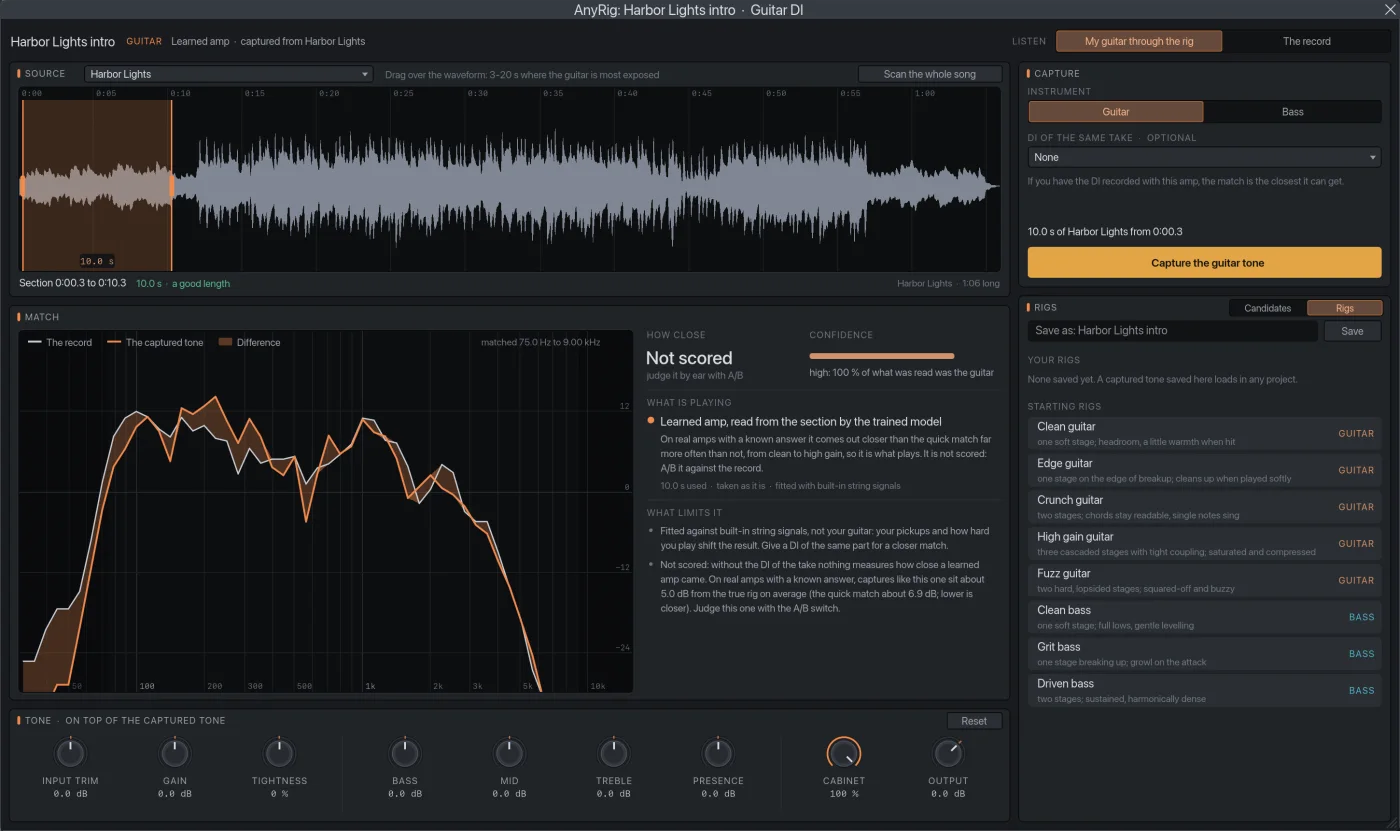
Drag over a few seconds of guitar or bass on any record. AnyRig listens, builds a neural model of that amp and cabinet, and puts your own guitar through it.
Listen
Four captures. For each: the record AnyRig listened to, a dry guitar or bass playing a different part, and that dry part through the captured tone. AnyRig was given the record and nothing else. These examples are synthesized so they can be shared here.
How it works
Pick three to twenty seconds where the instrument is easy to hear: an intro riff, a break, a solo. AnyRig separates it from what's around it, and a trained model reads the amp from the sound: how it distorts, how it responds to playing, the cabinet's voice. A quick match lands in a few seconds and the learned amp about a second later. What you play through afterwards is a small neural network running in real time, with no added delay.
Amp and cabinet, nothing else
The model can only hold a few hundredths of a second of sound, so the reverb, delay and modulation on the record stay on the record. You get the amp tone dry, and add your own space.
Scan a whole song
Let AnyRig go through the song and it finds every stretch where the guitar or bass plays, notices when the tone changes between verse and chorus, tells apart guitars panned left and right, and offers each as its own rig with a note on how clearly it could be heard.
Make it yours
Gain, bass, mid, treble, presence, tightness and cabinet sit on top of the captured tone. Switch between your guitar through the rig and the record at matched loudness to judge it. Save a rig and it loads in any project.
If you have the DI
When you have the dry track that was recorded with the amp, give AnyRig both. It learns the amp from the pair in about a minute, which is the closest match there is.
What to expect from a beta
AnyRig makes a match, not a clone. Tested on 169 real amps and pedals it had never heard, with recordings where the true answer was known, it came closer to the real rig than a conventional tone match in 421 of 507 captures, from clean to high gain. Fuzz lands furthest from the record. A guitar sitting in the centre of a dense mix under a vocal can't be pulled out, so choose a section where it's exposed. It has no way to know your pickups unless you give it a DI. It doesn't put a number on a capture made without the DI, because no measurement of that holds up: use your ears and the A/B switch.
get me the guitar tone from this intro→Captures the amp from the section you point at and puts it on your guitar track.
scan the song for guitar tones→Lists each rig it finds, with how much clear material there is.
more gain, less fizz→Turns the captured amp up and pulls the presence down.
let me hear the record→Switches the A/B to the original section at matched loudness.
Credits
AnyRig's tone model was trained in part on EGFxSet by Hegel Pedroza, Gerardo Meza and Iran R. Roman (CC BY 4.0, doi:10.5281/zenodo.7044411) and on Guitar-TECHS by Hegel Pedroza, Wallace Abreu, Ryan M. Corey and Iran R. Roman (CC BY 4.0, doi:10.5281/zenodo.14963133). It also used amplifier captures and recordings from the TONE3000 neural-amp-modeler-wasm repository (MIT License, Copyright (c) 2026 TONE3000) and cabinet impulses by Jester Dyne (CC0).
Included free with Audizer.For Apple Silicon Macs and Windows. No separate licence, no add-on to buy.
Download for Mac Free · Apple Silicon